Inside AWiM25 at the African Union: Scheherazade Safla on Gender,
Trending
Friday March 6, 2026

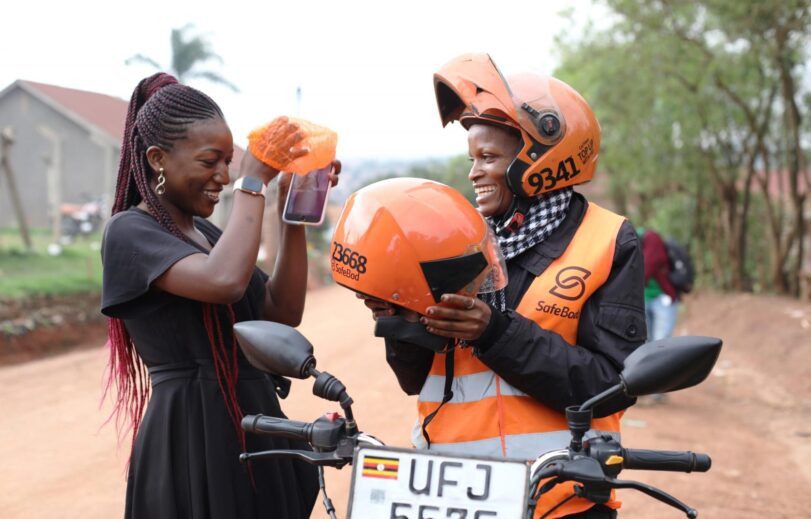
It is dawn in Makindye, a suburb of Kampala. Roscovia Akullo is up and preparing to leave for work.
She slips into her riding jacket, secures her helmet, fastens her boots, and adjusts her gloves. Outside, her motorcycle waits. She walks toward it, her steps steady, her purpose clear.
“This bike changed my life. It’s not just a job. It’s my independence,” she says, placing one hand on the handlebars.
Akullo is one of a growing number of women breaking into Uganda’s boda boda industry — a sector long dominated by men. By navigating the city’s bustling streets on two wheels, she is not only earning a living but also redefining gender roles in Uganda’s informal economy.
“I wake up at 5:00 a.m. every day to find early bird customers who travel for work. I ensure that by 6 a.m. I am already on the road. Customers at that time pay good money, between 5,000 and 10,000 shillings, depending on the distance,” Akullo shares as she starts her bike.
With Kampala’s gridlocked traffic and a population of over four million, motorcycles have become essential for quick transportation.
Over 150,000 registered boda bodas ply the city’s roads, offering both passengers and deliveries a convenient alternative to cars and taxis. Yet, women represent only a tiny fraction of this workforce.
“People stare when I pull up in traffic. Some laugh, some cheer. But I’ve learned to keep my eyes on the road and my head high,” says Akullo.
Being a female boda boda rider in Kampala, or even Uganda at large, requires courage for any woman, as the industry is known for its volatility, with frequent accidents and road safety concerns. Riders often navigate chaotic traffic conditions, and the risk of injury is ever-present.
In an industry often associated with such high accident rates, the presence of women riders could be more than just a shift in gender roles — it might be a step toward safer roads.
According to the Uganda Police Annual Crime Report, road traffic crashes involving boda bodas account for a significant number of injuries and fatalities. Male riders, who dominate the sector, are often cited for reckless driving, speeding, and ignoring traffic rules.
Female riders, however, are bringing a different energy to the road.
 Akullo (right) with fellow female boda boda riders at Nakasero Market, returning to their stage after completing a food delivery. Photo by Richard Mugambe.
Customers like Samuel Ssenyondo, a regular boda boda user, appreciate the professionalism that women bring to the industry.
“I have taken rides with both male and female riders, and I’ve noticed that the female riders tend to be more cautious and considerate. It’s not just about getting from point A to point B; it’s about having a pleasant experience during the ride, and yet on the other side, men don’t really care,” he shares.
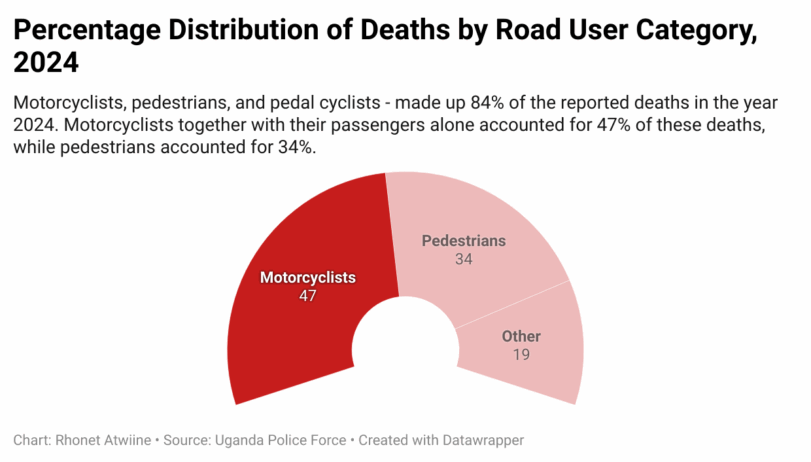 A chart illustrating the percentage of road fatalities by user category, with motorcyclists accounting for the highest proportion at 47%. Source: Uganda Police Force.
Women like Akullo face not only the dangers of the road but also societal stigmas that question their place in a traditionally male-dominated profession.
“I’ve been called names. Some people say it’s not right for a woman to ride a motorcycle, that we should stay at home or find ‘softer’ jobs. But I just smile and keep riding. I know why I’m doing this,” Akullo shares.
However, this is not the case for Akullo. She decided to break the barriers and join the sector, driven by the need for self-employment and financial independence.
“As a single mother of three, I needed money to run our home because my husband’s income wasn’t enough for all of us. When I looked around, I did not see any other business that could give me the daily income I needed besides the boda boda.”
Like many women, Akullo had been previously employed as a supermarket attendant. However, the demands of traditional employment pushed her into this business.
At Nakasero stage, where Akullo operates alongside 11 other women riders, she is constantly busy ferrying passengers and handling deliveries.
“This job isn’t only for men. On a good day, I make 30,000 UGX. In a good month, I earn 900,000 UGX. It has helped me provide for my children without depending on anyone,” she insists.
“When I see a woman confidently riding a motorcycle, it inspires me. It shows that women can do anything they set their minds to, even in male-dominated spaces like this one. This shift not only empowers the riders but also encourages us women to consider this profession,” says Miriam Nakayima, a student at Cavendish University.
A female passenger gets ready to board a boda boda operated by a woman along Nakareso Avenue in Kampala District. Photo by Rhonet Atwiine.
Vivian Nabisere, the Community Engagement, Learning, and Development Lead at SafeBoda, a motorcycle taxi-hailing start-up in the country, shares that there is hope for women to dominate the industry if key stakeholders in the nation’s transport sector take part and promote inclusion.
“We want women to join SafeBoda so that we can increase the number of female riders. This way, customers could have the option to choose a female rider on our mobile application. Parents, in particular, would appreciate it if a woman could drive their child to school—they feel safer,” she opines.
At a dusty lot in Kampala, Irene Nantongo grips the handlebars of a motorcycle with trembling hands. It’s her second week learning how to ride, but the fear is fading, replaced with something new: confidence.
“I used to depend on my boyfriend for everything,” she says, pausing to adjust her balance. “But I want my child to look at me and see a strong mother who works for her future.”
Nantongo is one of many women being trained by a local initiative, Women Rising for Africa, to enter the boda boda sector and change economic prospects for women through safe motorcycle riding.
The training goes beyond just learning how to ride. She’s picked up skills that will keep her safe on the road — reading traffic patterns, practicing defensive riding, first aid skills — and she’s also learning how to manage the income she hopes to earn.
“What surprised me most was learning how to protect myself in case someone harasses me. And we even had a session on family planning. I didn’t expect that, but it made me think more about the kind of future I want,” she says.
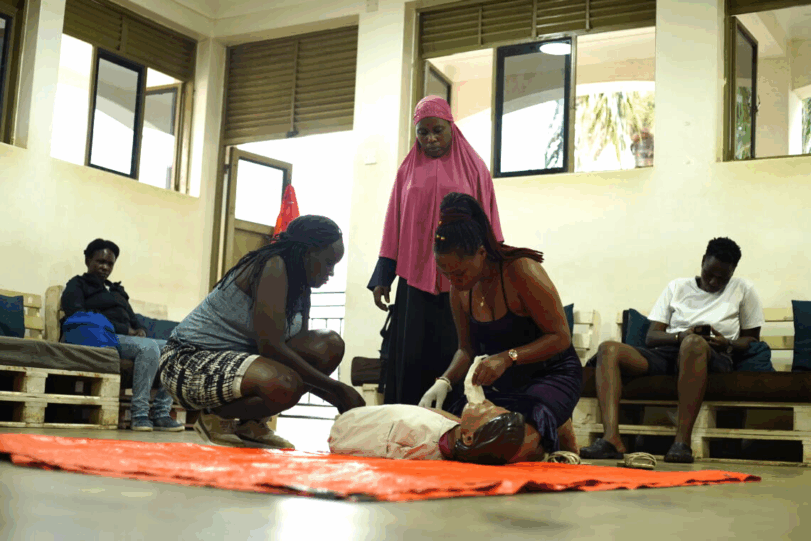
Women practice CPR under the guidance of an instructor during a training session designed to prepare them for emergencies on the road, including how to assist passengers in case of an accident. Photo by Richard Mugambe.
The model mobilizes women like Nantongo and Akullo, who come from diverse backgrounds and communities, with an emphasis on low-resource city communities, and works with other transport stakeholders to facilitate the training.
The idea is to prepare them for more than just transport work — to equip them for independence in every area of their lives. But not everyone sees it that way.
“Many families, especially husbands, think this is not a woman’s job. Some women have to fight just to be allowed to come,” says Liliane Felix, who leads the team behind the training.
Felix, originally from Spain, says her involvement began when she noticed how few women were on the road — and how unsafe public transport could be for them.
“Seven years ago, I came to Uganda as a tourist, but during my time here, I noticed the transportation safety challenges women encountered. Being proficient in motorcycle riding myself, I chose to impart my skills to them, aiming to dismantle barriers within the boda boda industry and for women.”
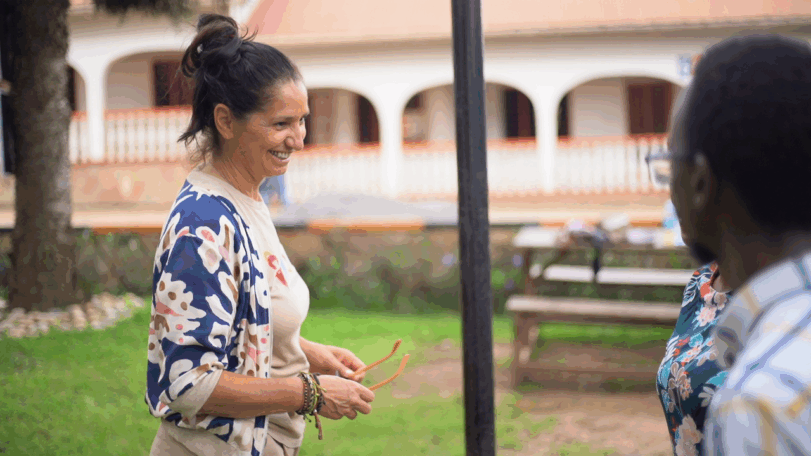
Liliane Felix, Founder of Women Rising for Africa, in conversation with some of the employees at the SafeBoda Academy in Kampala. Photo by Richard Mugambe.
Unlike most technical programs, this one builds in support networks. Once the training is complete, women can apply for help getting licenses and even soft loans to buy motorcycles. Some are linked to ride-hailing platforms like SafeBoda, which is actively encouraging more female riders to join.
Nabisere explains that they integrate women into the system, providing them access to passengers and opportunities to deliver goods for online businesses like Jumia, Glovo, and many other delivery companies.
“People don’t realize that the boda boda industry is very lucrative. These women are financially independent because they get paid every time they make a delivery or transport a passenger.
She further elaborates that there is a higher level of trust placed in women when it comes to handling products compared to men.
She notes that women tend to be more cautious, ensuring items are handled with care and responsibility.
“We have received positive feedback from SafeBoda customers, saying their items were delivered in good condition. Moreover, having more women on the road increases overall safety, as some male riders have been reported for theft, especially targeting women traveling at night,” Nabisere explains.
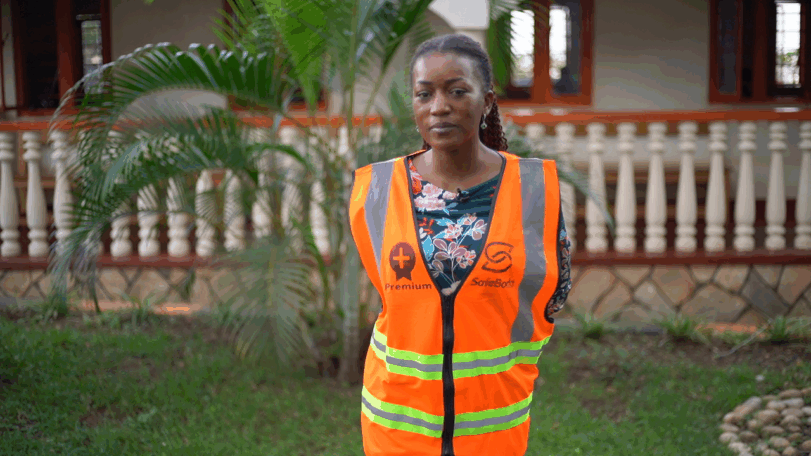 Vivian Nabisere, Community Engagement, Learning, and Development Lead at SafeBoda, during an interview at SafeBoda Academy in Kampala. Photo by Richard Mugambe.
Since 2022, dozens of women have taken up motorcycle riding after graduating from the program. Some now operate at busy stages like Nasser Road and Nakasero, where they’re gradually shifting the narrative.
However, Felix notes that the journey to empowering women to join this male-dominated sector is fraught with challenges.
Many families, particularly husbands, believe this is not a suitable job for their wives. Additionally, the prospect of taking out loans deters many women.
“Coming from humble backgrounds, they see a loan as a daunting commitment. We had to educate them on manageable repayment methods, and now it is no longer an issue.”
Akullo also mentions that some customers, especially men, are hesitant to let her drive them to their destination, fearing that she may cause an accident because they believe she isn’t as strong or skilled as the men in the business.
“Some female customers underestimate me when they see me on stage. They think I will cause an accident or we will fall. Someone might initially be interested in taking the boda, but once they realize I’m a woman, they leave and choose a male rider. My favorite customers are male because they do not undermine me, but rather are curious,” she explains.
She adds that when the road is busy, some male riders drive recklessly, and sometimes customers refuse to pay after reaching their destination.
Despite these challenges, Akullo remains hopeful. Her ability to provide for her family and the changing attitudes within her household about the boda boda business are significant achievements.
“There were days I thought about quitting — when men would laugh, or when passengers refused to board. But then I remember why I started. My children. My freedom,” she says.
She revs her engine, ready to take on another day in the city.
“I want my daughters to see that their mother rode against the wind and paved the way. We are not just riding motorcycles — we are rewriting our story.” Akullo says.
This report was supported by the African Women in Media (AWiM) with support from the Fojo Media Institute.

Recent Comments